
PAM buyer's guide: how to evaluate PAM vendors and tools
A neutral PAM buyer's guide: evaluation criteria, questions for every vendor, a weighted scoring template and proof-of-concept tests. Score your shortlist.
Key takeaways
- Evaluate PAM platforms against your own systems, identity provider and workflows, not against a vendor's feature list.
- The criteria that decide most PAM projects are agents on targets, just-in-time access, live session enforcement, the vault, audit integrity, deployment and identity integration.
- A weighted scoring template set before demos keeps the shortlist decision tied to requirements rather than presentation quality.
- A proof of concept should run the same scenarios on every product: a just-in-time request, a blocked command, a desktop action, a credential rotation and an audit export.
- Ask every vendor to answer from its own published documentation, and record the link next to each answer.
This PAM buyer’s guide gives you a neutral way to evaluate privileged access management platforms: the criteria that decide most projects, the questions to put to every vendor, a weighted scoring template, and a proof-of-concept scenario list you can run on any shortlist. It is written for security leaders, infrastructure engineers and procurement teams choosing a PAM platform. Where it helps, we give SWOT PAM’s own documented answer as one worked example, so you can see what a sourced response looks like. We make no claims about other vendors’ products here: ask them the same questions and record their documented answers beside ours.
Privileged access management (PAM) is the set of controls that govern accounts and sessions with elevated rights: storing and rotating their credentials, granting access only when needed, brokering and recording privileged sessions, and keeping an audit trail that shows who did what, where and when.
PAM buyer’s guide basics: what a PAM platform should do
Start from the principle the controls serve. NIST defines least privilege as granting each entity the minimum authorisations and resources it needs to perform its function. A PAM platform turns that principle into daily practice for administrators, database engineers, contractors and service accounts.
In practice the capabilities group into seven areas: how the platform reaches targets, how access is granted and removed, what it does during a live session, how shared credentials are stored and rotated, how it proves the audit trail is intact, where it runs, and how it fits your identity stack. NIST’s zero trust architecture guidance adds a useful test: trust should not follow from network location, and authentication and authorisation should happen before each session. Our PAM glossary entry covers the vocabulary in more depth.
PAM evaluation criteria and the questions to ask any vendor
Use these criteria as the rows of your requirements document. For each, the question is the one to send to every vendor, and SWOT PAM’s answer shows the kind of specific, documented reply you should expect.
| Criterion | Question for every vendor | SWOT PAM’s documented answer |
|---|---|---|
| Agents on targets | Which components must be installed on servers, desktops or endpoints for the features we need? | None. Inspection happens at the proxy for SSH, RDP, PostgreSQL and Oracle Net. |
| Just-in-time access | How are temporary privileges requested, approved and removed, and is removal automatic? | Time-bound grants with ticket or justification; approvals in Slack, Microsoft Teams or email; the grant expires on its own. |
| Live enforcement | Can a risky session be frozen or ended while it is live, or only reviewed afterwards? | PAMGuard scores the session: at 40 it is watched more closely, at 70 input freezes until an admin decides, at 150 it ends. Blocking rules drop a matching command before the target receives it. |
| Windows desktop sessions | What is captured from a graphical session, and does it need an agent? | Agentless analysis of RDP keystrokes, clipboard, mouse-driven actions and window titles such as regedit. |
| Vault and rotation | How are shared credentials stored, checked out and rotated? | AES-256-GCM vault with a unique IV per record and the master key outside the database; check-out and check-in; rotation on a schedule or after check-in; dual approval for sensitive systems. |
| Audit integrity | How can an auditor verify that logs and recordings have not been changed? | SHA-256 hash chain over events, insert-only audit tables, a hash per recording, optional S3 or MinIO storage with Object Lock. |
| Deployment | Which deployment options exist, and what infrastructure does each need? | Self-hosted in the cloud, on-premises or hybrid; seven containers on Docker Compose or Kubernetes; an offline bundle for air-gapped sites. |
| Identity integration | Which identity providers and MFA methods are supported in the edition we would buy? | SAML 2.0 and OIDC with Entra ID, Okta, Google, OneLogin and PingFederate; TOTP MFA; LDAP and Active Directory sync. |
| User experience | Can engineers keep their own clients, and can contractors connect without installing anything? | Native SSH on port 2222, RDP on 33890, database clients on 5454 and 1521, or browser consoles for terminal, desktop and SQL. |
| Compliance evidence | How does the platform map its evidence to the frameworks we report against? | A Compliance Hub maps ISO 27001, SOX, PCI DSS and HIPAA controls to session records, approvals and audit events. |
Two follow-up questions apply to every row. First, is the capability in the edition and licence you are being quoted, or an add-on? Second, where is it documented? Ask for the link and file it with the answer.
A weighted scoring template for PAM vendors
Agree weights before the first demo, while nobody has a favourite. Weights should reflect your risks: an organisation with many Windows administrators weights desktop session coverage higher; a regulated bank with air-gapped sites weights deployment and audit integrity higher. Score each criterion from 0 to 5 using evidence from documentation and the proof of concept, not from slides.
| Criterion | Weight (total 100) | Vendor A score (0 to 5) | Vendor A weighted | Vendor B score (0 to 5) | Vendor B weighted |
|---|---|---|---|---|---|
| Agents on targets | 10 | ||||
| Just-in-time access | 15 | ||||
| Live enforcement | 15 | ||||
| Windows desktop sessions | 10 | ||||
| Vault and rotation | 15 | ||||
| Audit integrity | 10 | ||||
| Deployment fit | 10 | ||||
| Identity integration | 10 | ||||
| User experience | 5 | ||||
| Total | 100 |
Calculate each weighted value as weight times score divided by 5, so a perfect product scores 100. Use a simple scale and write down what each score means:
- 0: not available, or only on the roadmap.
- 1 to 2: available with significant gaps or an add-on outside the quote.
- 3: meets the requirement as documented, not yet tested.
- 4: meets the requirement and passed the proof-of-concept scenario.
- 5: passed the scenario and produced evidence your auditor accepted.
Keep cost in a separate sheet. Normalise licence quotes to your own counts of users, targets and concurrent sessions, then add infrastructure, implementation and annual running effort.
PAM proof-of-concept scenarios
A demo shows what a vendor chooses; a proof of concept shows what happens on your systems. Run the same scenarios on every shortlisted product, with your identity provider connected and real, non-production targets. Record pass or fail and keep the evidence each one produces.
- Just-in-time request: an engineer asks for read-only access to a database for two hours, citing an incident ticket. Check who is notified, how approval works, and that access ends when the window closes without anyone revoking it.
- Blocked command: run a destructive command such as
rm -rfon a Linux test host andDROP TABLEon a test database. Check whether it is stopped before the target receives it, or only recorded. - Escalating session: run a privilege escalation such as
sudo su -followed by further risky commands. Check whether the session is flagged, frozen for approval, or ended. - Windows desktop action: open regedit or Credential Manager, and delete a file with the mouse. Check what is captured without an agent.
- Credential rotation: check out a vaulted password, use it, check it in, and confirm the old value no longer works on the target.
- Native and browser access: connect once with an engineer’s own SSH or SQL client and once from a browser as a contractor. Confirm neither sees the target password.
- Leaver: disable a user in the directory and confirm their PAM access ends at the next sync.
- Audit export: export a day of events and recordings, then try to alter one row. Check how the change is detected.
- Failure: stop one proxy instance during a session and note what users see and how the platform recovers.
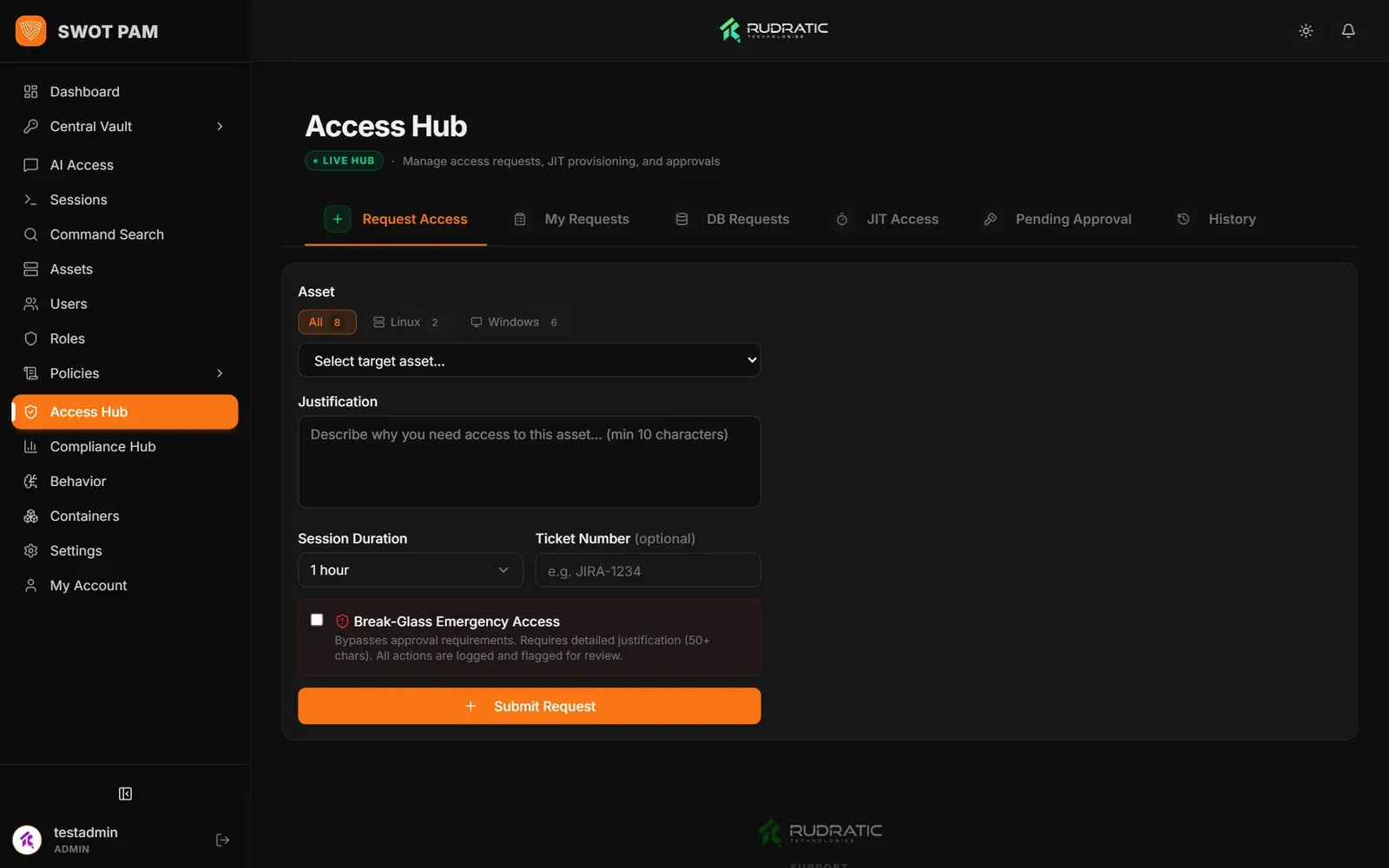 SWOT PAM: the Access Hub, where users request time-bound access and follow approvals.
How SWOT PAM answers the proof-of-concept scenarios
For the scenarios above, SWOT PAM’s documented behaviour is as follows. Test it the same way you test every other product.
In the just-in-time scenario, a user picks the target, duration and reason, or asks the AI access assistant in plain English, for example “I need read-only access to the billing PostgreSQL database for 2 hours to investigate incident INC-902”. Approvers are told in Slack, Teams or email, the proxy injects the credential, and the grant expires on its own. Read more in our just-in-time access overview.
For blocked and escalating commands, admins write PAMGuard rules as patterns with an action: block and alert, flag the session, or end it. The admin guide’s examples include a rule that blocks rm -rf /, a rule that drops DROP TABLE at the database proxy, and a rule that adds 30 to the risk score for sudo su -. Directory groups map to roles such as devops, dba and vault_admin, and the administrator guide says the LDAP or Active Directory sync disables terminated accounts.
For the audit export, every event is sealed with a SHA-256 hash of itself and the previous event, so editing one row breaks every later hash, and the Audit Integrity Worker flags it. The architecture documentation describes the stateless API server, SSH proxy and RDP gateway, which you can run as several instances behind a load balancer for the failure scenario.
Mapping PAM criteria to control frameworks
Most buyers also need to show how the platform supports their control framework. NIST SP 800-53 Rev. 5 is a common reference catalogue for access control, audit and accountability, and identification and authentication controls. Map each scoring criterion to the controls you report on, then ask each vendor which evidence its platform produces for that control.
Treat the result as evidence support, not compliance. A PAM platform produces approvals, session records and audit events; whether a requirement is met depends on configuration, scope and your assessor. Our PCI DSS privileged access page shows how SWOT PAM’s evidence lines up with one framework.
Next steps
A good PAM buyer’s guide comes down to fixed criteria, the same questions for every vendor, weights agreed in advance and a proof of concept on your own systems. For side-by-side detail, read our evaluation guides for SWOT PAM vs CyberArk and SWOT PAM vs BeyondTrust. To run these scenarios on your own servers and identity provider, book a SWOT PAM demo.
Questions
How long should a PAM proof of concept take?
Long enough to run every scenario on your list against real targets, with your identity provider connected and at least one rotation cycle completed. Agree the scenarios, success criteria and evidence each vendor must produce before it starts, so duration follows scope rather than sales timelines.
Who should be on a PAM evaluation team?
Include the security owner, an infrastructure or platform engineer who will run the system, a database administrator, a Windows administrator, someone from identity and access management, and an auditor or GRC lead who will consume the evidence. Each tests the scenarios that touch their own work.
Should we score PAM vendors on price?
Score total cost separately from capability. Licence models differ, so normalise them to your own counts of users, targets and concurrent sessions, then add infrastructure, implementation and run costs. Keeping cost out of the capability score stops a cheap product winning on weaker controls.
Is a PAM platform enough to meet PCI DSS, SOX or HIPAA?
No product meets a control on its own. A PAM platform helps produce evidence such as approvals, session records and audit events. Whether a requirement is met depends on how you configure it, what is in scope, and what your assessor accepts.
Sources
Products in this post

Keep reading
See it on your own systems
A walk-through of the products with the team that builds them.